Why Kenya National Park Vehicle Entry Fees Matters
Not all Kenya National Park Vehicle Entry Fees choices work the same way. One example may have a long transfer or different inclusions; another may have the right activities but an uncomfortable schedule for your group.
You do not need specialist knowledge to compare the options. Start with the destinations, dates, logistics and inclusions explained below, then confirm any changing prices or restrictions before booking.
Kenya National Park Vehicle Entry Fees Planning Spectrum: From Ideas to Confirmation
Use this planning scale to move from your first ideas to details you can verify. It is not a rating of suppliers.
1. Start with the basics
2. Compare suitable options
3. Check practical details
This is a starting point. Your dates and priorities determine the right next step.
Quick Picks: What Are You Planning?
Choose the question closest to yours and jump directly to the relevant sections.
| Your situation | Quick picks |
|---|---|
| I want to identify the main fees | Official KWS vehicle charges · Four transport-related costs that are easily confused |
| I need a comparison of categories | Seating capacity versus actual group size · Work a full admission example without inventing a package |
| I am working out the full cost | Multiple parks, exits and overnight stays · KWS parking and other specialist provisions |
| I need payment and access details | Independent conservancies and county reserves differ · Questions to include in the safari inquiry |
Common Kenya National Park Vehicle Entry Fees Choices and What They Are Best For
The following topics preserve the existing article guidance, organized so you can compare the details more easily.

1. Official KWS vehicle charges
Start with the basics
| Vehicle seating capacity | Currency | Amount |
|---|---|---|
| Fewer than 6 seats | KES | 600 |
| 6 to 12 seats | KES | 1,500 |
| 13 to 24 seats | KES | 3,000 |
| 25 to 44 seats | KES | 4,500 |
| 45 seats or more | KES | 5,000 |
Schedule effective . Amounts checked . Official KWS tariff; implementation notice. These are existing rates used for 2026 planning, not newly announced 2027 prices. Confirm eligibility and the applicable charging period before payment.
The original official schedule was checked October 27, 2026. These are existing amounts effective October 1, 2025, not a newly announced universal 2027 tariff. Keep the seating labels intact. Changing “fewer than six” to “six or fewer” would put a boundary vehicle into the wrong band.
The charge is listed per vehicle per day. It is not a per-passenger fare and does not pay conservation admission for the people aboard. Ask which provision applies when an operator has a relevant annual or commercial authorization. A general table should not be used to add an extra daily charge to a quotation without first understanding how the operator has accounted for entry.
Best for: Your priorities Practical comparisons Written confirmation
2. Four transport-related costs that are easily confused
Start with the basics
Vehicle entry is the authority’s charge for the applicable vehicle access. Passenger conservation admission is assessed individually by category. Vehicle hire is the service you arrange with a supplier, potentially including a driver, fuel, time and transfers. Parking is another provision that may apply in particular circumstances. Similar labels on a quote do not make these the same purchase.
Ask for scope before comparing figures
A driver collecting you at an airport, a car dropping you outside a park and a safari vehicle available for private wildlife viewing are different services. The entry table cannot price the driver’s working day, the distance traveled or a multi-day assignment. Ask what the transport line actually covers before comparing it with another supplier’s headline.
Keep any optional airstrip transfer or onward coast connection visible. A safari vehicle booking does not automatically include every journey before and after the wildlife program. If a quotation ends at a railway station, establish whether the next transfer and ticket are separate rather than assuming a door-to-door service.
Best for: Budget planning Official terms Clear inclusions
3. Seating capacity versus actual group size
Compare suitable options
A vehicle with fewer than six seats uses the first printed band. A vehicle with six seats uses the next band even if only two guests ride. Do not count empty seats as absent capacity, and do not assume that the number of paying safari guests equals the vehicle’s tariff classification. Request the applicable vehicle details from the provider.
Group size still matters for cost sharing. If a KES 1,500 vehicle charge is shared equally by three guests, the arithmetic allocation is KES 500 each; if shared by five, it is KES 300 each. That calculation does not change the authority’s total or each traveler’s own conservation admission. It is a way to understand a quote, not permission to alter the official category.
For children and mixed-age groups, confirm safe and lawful seating and any required child arrangements separately. A free or reduced child conservation admission does not mean the child takes no space in transport. Do not choose a smaller vehicle solely to reach a cheaper entry band when it cannot appropriately carry the group and luggage.
Best for: Group goals Venues and services Coordination
4. Work a full admission example without inventing a package
Compare suitable options
Consider two eligible Kenya-resident adults entering Nairobi National Park in a vehicle with fewer than six seats. Conservation admission is KES 1,350 each, totaling KES 2,700. Add the standard KES 600 vehicle line and the illustrated entry subtotal is KES 3,300. The calculation excludes vehicle hire, guiding, fuel, food and any other admission periods.
If that vehicle instead falls in the six-to-twelve band, the vehicle component becomes KES 1,500, making the corresponding subtotal KES 4,200. The change comes from vehicle classification, not a different resident admission rate. Keep the lines separate so that the reason for a revised total is clear.
For a group containing East African citizens, Kenya residents and USD-priced visitors, calculate the individual admissions first. Preserve KES and USD subtotals until the payment or quotation states the exchange basis. A single unexplained converted total can conceal either a classification mistake or a duplicated charge.
Best for: Your priorities Practical comparisons Written confirmation
5. Multiple parks, exits and overnight stays
Check practical details
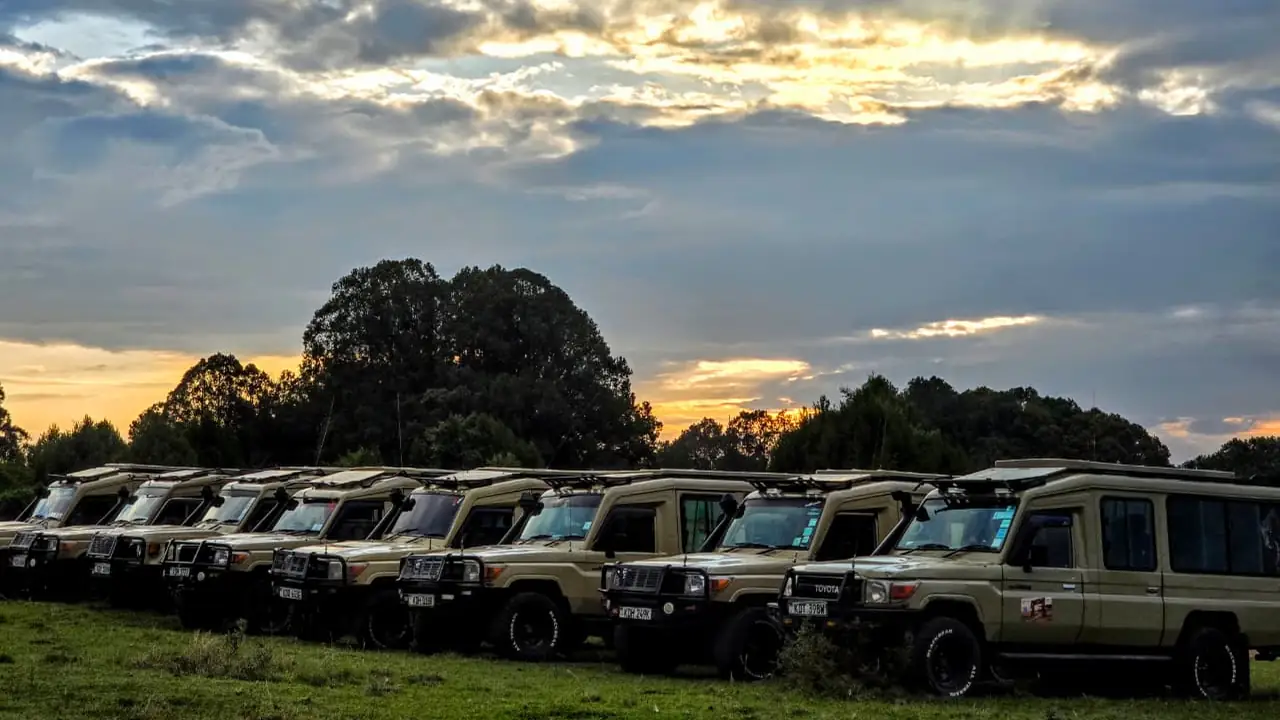
List every planned protected-area entry and charging period. A route visiting two KWS parks should not be budgeted as one vehicle line merely because the same car is used. Conversely, do not multiply by every calendar label without confirming the applicable access and any official package or authorization. The actual ticket arrangement matters.
KWS defines a daily fee for single access over a period not exceeding twenty-four hours. That definition does not establish unlimited re-entry, unrestricted nighttime driving or reciprocal access to every park. Ask how an overnight base outside a boundary affects the itinerary. A supplier should explain the access pattern behind its admission and vehicle totals.
For a multi-day hire, clarify when the vehicle and driver are available to the group, which transfers are included and whether any days are transfer-only. The full service can cost more than the authority fees even when the entry calculation is correct. Compare the same journey and availability, not just the number of nights.
Best for: Your priorities Practical comparisons Written confirmation
6. KWS parking and other specialist provisions
Check practical details
The official sheet has a parking line for specified KWS locations, including Hell’s Gate and Lake Nakuru, and states that it does not apply to park visitors with paid tickets. Do not automatically add it to ordinary paid visitor entry. Ask KWS which arrangement applies if your visit involves unusual parking, external facilities or a nonstandard purpose.
The schedule also contains provisions for trucks, aircraft, boats and annual tourist-service or commercial vehicles. Those are not interchangeable with a normal visitor-car line. A filming project, delivery operation or vehicle stationed in a park should obtain the relevant classification directly rather than use the cheapest tourist example from a blog.
Special activity permission can also be separate from transport access. Driving into a park does not authorize off-road use, commercial filming or unrestricted operation of equipment. Ask the authority about the intended activity and required approval. A fee paid under the wrong provision does not settle those permissions.
Best for: Your priorities Practical comparisons Written confirmation
7. Independent conservancies and county reserves differ
Prepare to enquire
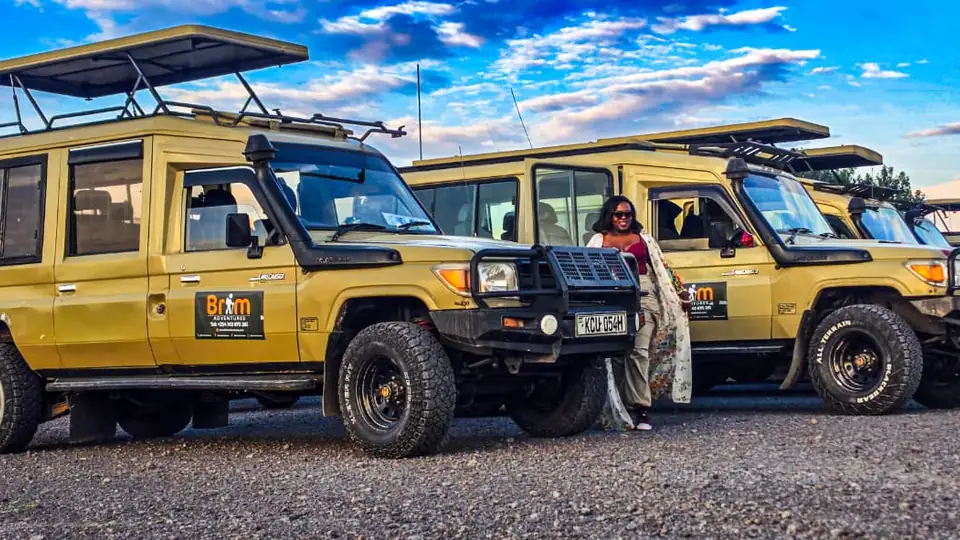
Ol Pejeta’s official 2026 guide uses a different vehicle table: its first band includes up to six seats, unlike the KWS first band. The guide also leaves thirteen- and fourteen-seat vehicles unspecified. The Ol Pejeta guide preserves that gap for direct confirmation instead of inventing a band.
County reserves have their own administration and charges. Do not put a KWS vehicle amount into a Mara or Samburu budget without the relevant authority’s confirmation. Matching wildlife activities or similar-looking vehicles do not establish a common national tariff. A proposal should name the protected area and the charge being used.
Use the national fee hub to identify the authority before applying a table. Where a current county amount cannot be established, keep the line pending. An honest provisional figure is preferable to a confident total assembled from unrelated parks.
Best for: Your priorities Practical comparisons Written confirmation
8. Questions to include in the safari inquiry
Prepare to enquire
Ask for vehicle type, applicable seating class, private or shared use, pickup and final drop-off, luggage arrangements and the periods available for wildlife viewing. Request a clear statement about conservation admission, vehicle entry, guiding, fuel and optional transfers. If a charge is already included, do not pay it again independently without clarification.
Send group details and route preferences through Brim’s safari page or the inquiry form. For a specific city outing, use the Nairobi private safari page. The aim is a complete transport arrangement whose entry arithmetic can be checked, not the lowest vehicle number detached from the actual service.
Best for: Your priorities Practical comparisons Written confirmation
Four Booking Tips for Kenya National Park Vehicle Entry Fees
When planning Kenya National Park Vehicle Entry Fees, check four practical things:
- Match the dates. Ask what is suitable for your real travel window.
- Read the daily schedule. Look at transfers, rest and activity time.
- Check every inclusion. Confirm accommodation, fees, transport and optional services in writing.
- Review current conditions. Ordinary changes in weather or wildlife movements are possible; confirm official guidance and supplier terms.
Preparing for Kenya National Park Vehicle Entry Fees and What to Check
Before travelling, write down three priorities so the route and services can be planned around your group. Keep all names, dates and inclusions together in the paperwork you share with the other travellers or event organizer.
Worth knowing: a sample plan is not a confirmed booking. Review two documents before you pay: the written itinerary and the itemized quotation. If they disagree, request a corrected version.
3
Priorities to specify before planning
2
Documents to compare before booking
Plan Kenya National Park Vehicle Entry Fees with Brim Adventures
Brim Adventures helps travellers and groups plan around their dates, priorities and the practical details of each journey. Compare options here, then request a written itinerary with confirmed arrangements.
Explore more planning guides or request a personal quotation before deciding.
Published · Travel guide
Official sources and verification
Sources checked 27 October 2026. Source publication dates and tariff effective dates are identified in the text. Recheck changing information before payment or travel.
Frequently asked questions
Is a six-seat vehicle in the first KWS band?
No. The first band is fewer than six seats. Six belongs to the six-to-twelve band. Other authorities may use different boundaries.
Does a vehicle fee cover everyone’s admission?
No. Individual conservation admission and vehicle access are distinct. A supplier may combine them in a package only with clearly stated inclusions.
Can I use the KWS table at every reserve?
No. County reserves and independent conservancies set their own arrangements. Match the charge to the actual managing authority.
Does vehicle entry pay the driver’s full service?
No. Driver time, fuel, hire and transfers are service components separate from the authority’s entry charge.
Plan your Kenya journey
Share your dates, traveler numbers, interests and preferred pace. Request a written itinerary and quote with confirmed availability and inclusions.
Request a Quote WhatsApp Brim